
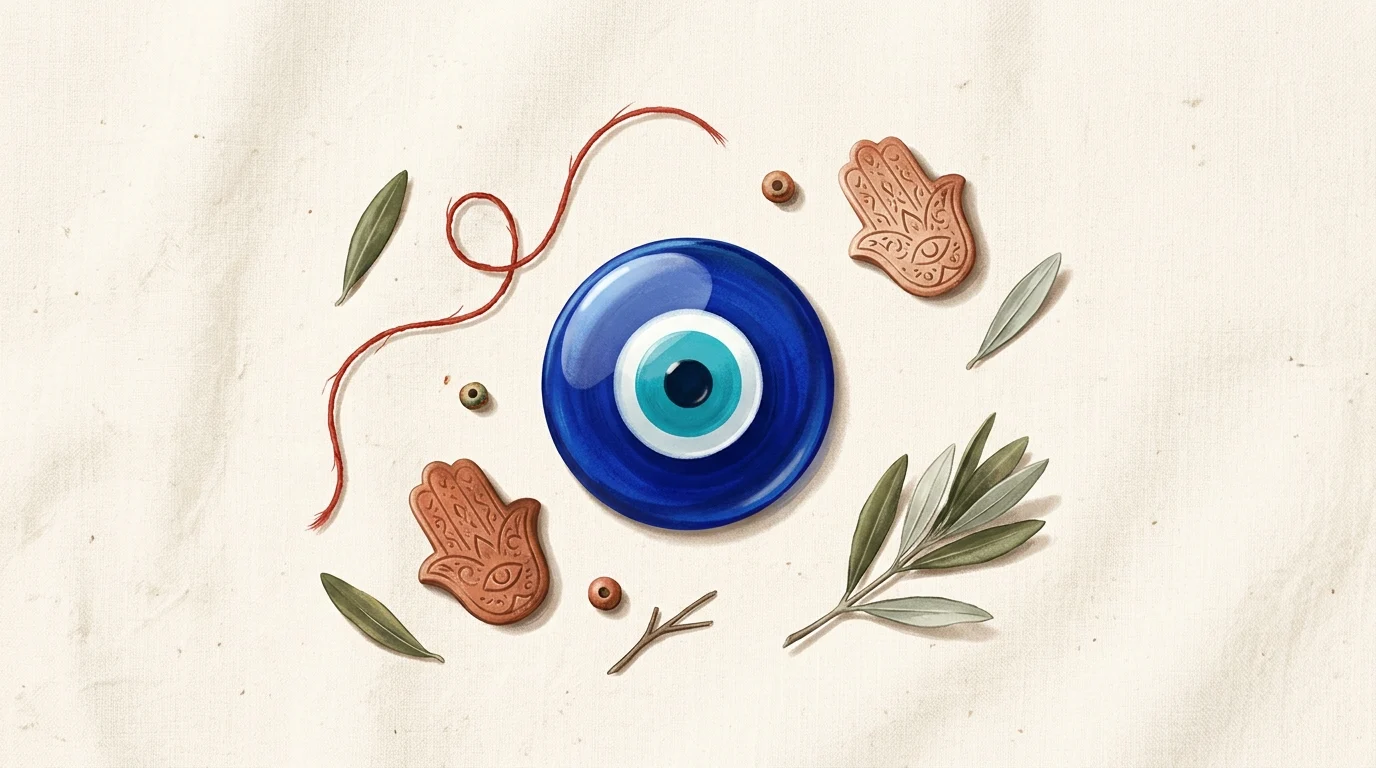
Quick Answer: The evil eye means a glance or stare believed to cause harm, misfortune, illness, or bad luck to the person or thing it falls upon. It is one of the oldest and most widespread folk beliefs in the world, found across Mediterranean, Middle Eastern, South Asian, and European cultures . The belief holds that envy or malice, often transmitted through a look, can damage someone’s health, property, or happiness, particularly if that person is beautiful, prosperous, or vulnerable .
Few folk beliefs have traveled as far or survived as long as the evil eye. From ancient Sumerian texts five thousand years old to modern jewelry worn around the world, the idea that a hostile or envious gaze can cause real harm has persisted across continents and religions . You will find references to it in the Bible, the Quran, and rabbinic literature, as well as in the everyday protective practices of families in Greece, Italy, Turkey, India, and beyond .
What makes the evil eye so enduring is not just superstition. It touches on something deeply human: the fear of being seen, the anxiety of envy, and the desire to protect what we love. The evil eye is not a single, uniform belief. Its meaning shifts depending on where you encounter it, who is doing the casting, and what is being protected. This article explains the core meaning of the evil eye, its origins, how different cultures understand it, and the common ways people guard against it.
What Does Evil Eye Mean?
At its core, the evil eye refers to a belief that a look, often motivated by envy or admiration, can cause harm . The harm can range from minor misfortune to serious illness or even death. The American Psychological Association defines it as a folk belief in the supernatural power of a malevolent stare, and notes that it is specifically recognized as a culture-bound syndrome in Mediterranean countries under the term mal de ojo .
Importantly, the evil eye is not always intentional. In many traditions, the person casting it may not even realize they are doing it. A passing glance of admiration at a beautiful child, a compliment about someone’s prosperity, or a moment of unconscious envy can be enough to trigger the effect . This is why in many cultures, praise is often followed immediately by a protective phrase. In medieval Europe, people said “God bless it” after complimenting a child. In Islamic tradition, saying Mashallah (what God has willed) is a way to acknowledge something good without inviting harm .
The belief also carries a strong association with envy. The evil eye is often understood as the harmful consequence of someone else’s jealousy or resentment. Those who are most vulnerable are typically those who have something to be envied: beauty, health, fertility, wealth, or happiness .
Where Does the Belief Come From?
The evil eye is ancient. It appears in Sumerian texts from around 3000 BCE, in ancient Greek and Roman writings, and in the foundational texts of Judaism, Christianity, and Islam . The belief is not confined to one region. It is found throughout the Indo-European and Semitic world, from India and Iran to the Mediterranean and Northern Europe .
However, the evil eye is not universal. Anthropological surveys note that it is largely absent from aboriginal Australia, Oceania, native North and South America, and sub-Saharan Africa, except where Islamic influence has spread . In Latin America, the belief arrived with Spanish and Portuguese colonizers and became embedded in local cultures .
Classical scholars debated the nature of the evil eye. Plutarch discussed it in his Table Talk, and Saint Basil dismissed it as “old wives’ gossip” . The Arab historian Ibn Khaldun considered it a natural, involuntary power rather than deliberate sorcery, arguing that a person who kills with the eye should not be treated the same as someone who kills with intent . This debate, whether the evil eye is intentional or involuntary, continues to shape how different cultures respond to it.
How Different Cultures Understand the Evil Eye
In Islamic Tradition
The evil eye (al-ʿayn) is well established in Islamic belief. A hadith attributed to the Prophet Muhammad states that “the evil eye is a reality” . The Quran itself recommends seeking refuge from the evil of the envious . At the same time, orthodox Islamic teaching has sometimes cautioned against excessive superstition. The belief is deeply embedded in popular practice across Muslim countries, where it is often associated with envy and is believed to affect children, mother to be women, and anything beautiful or valuable .
In Mediterranean and Middle Eastern Cultures
In Mediterranean societies, the evil eye is often called mal de ojo (Spanish) or matiasma (Greek). The belief is closely tied to the idea that excessive admiration or praise, especially of children, can bring harm. Protective measures include wearing blue beads, hanging amulets in homes, and using hand gestures . The blue eye symbol, now a popular fashion motif, originates from this protective tradition .
In South Asian Traditions
In India and neighboring regions, the evil eye (nazar or drishti) is a common concern, particularly for infants and mother to be women. Practices to ward it off include blackening a child’s face with soot or kohl, using lemon and chili charms, and performing rituals to remove the effects of a jealous gaze . The fear is often tied to social dynamics: neighbors, relatives, or strangers who may harbor envy.
In Western and Modern Contexts
Even in modern, secular societies, remnants of evil eye belief persist. The APA recognizes it as a culture-bound syndrome, and medical literature notes that patients in Western clinical settings sometimes describe symptoms they attribute to the evil eye . The symbol has also been commercialized: blue eye pendants and hamsa hands are sold as fashion accessories, often stripped of their original protective meaning . For many people today, the evil eye is less a literal threat and more a cultural inheritance or a way of expressing the vague sense that good fortune can attract misfortune.
How People Protect Against the Evil Eye
Protection against the evil eye takes many forms, but the underlying logic is consistent: deflect, distract, or absorb the harmful gaze. Common methods include:
- Amulets and talismans: Blue glass eyes, hamsa hands, red strings, and coral horns are among the most widespread protective objects .
- Verbal protection: Saying phrases like Mashallah, “God bless,” or spitting three times after praising someone is believed to neutralize the effect .
- Physical concealment: In some cultures, children’s faces are deliberately marked or dirtied to make them less attractive to envy .
- Ritual removal: When harm is believed to have occurred, healers may use salt, alum, fire, or specific plants to diagnose and cure the effects .
- Behavioral avoidance: Some people avoid excessive praise, keep good news private, or refrain from displaying wealth or beauty too openly.
Frequently Asked Questions
What does evil eye mean in simple terms?
The evil eye is a belief that a look, often driven by envy or malice, can cause harm, illness, or bad luck to the person it falls upon. It is a widespread folk belief found in many cultures around the world .
Is the evil eye real?
Whether the evil eye is “real” depends on what you mean. As a physical or supernatural force, there is no scientific evidence supporting it. However, as a cultural belief and a psychological phenomenon, it is very real: millions of people organize their behavior and protective practices around it, and the APA recognizes it as a culture-bound syndrome .
Who is most vulnerable to the evil eye?
Across cultures, the most commonly protected individuals are mother to be women, newborn babies, and young children . Anything considered beautiful, prosperous, or fortunate is also thought to attract envy and therefore requires protection.
Is the evil eye always intentional?
No. In many traditions, the evil eye can be cast unintentionally, through a moment of unconscious envy or even excessive admiration. A person with a “naturally injurious” gaze may harm others without meaning to .
What is the blue eye symbol and does it protect against the evil eye?
The blue eye, often called a nazar or evil eye bead, is a protective amulet meant to deflect the harmful gaze. It is widely used in Turkey, Greece, the Middle East, and beyond. In modern times, it has also become a popular fashion and decor item .
Can the evil eye be cured or removed?
Many cultures have specific rituals for diagnosing and removing the evil eye, ranging from reciting prayers and burning herbs to using salt or alum . These practices are usually performed by traditional healers or family elders and are understood within the cultural framework of the community.
Conclusion
The meaning of the evil eye is layered. On the surface, it is a superstition about a harmful glance. Beneath that, it is a way of talking about envy, vulnerability, and the risks that come with good fortune. The belief has survived for thousands of years because it maps onto real human experiences: the discomfort of being watched, the fear of losing what we value, and the instinct to protect the people we love.
Whether you treat the evil eye as a literal force, a cultural tradition, or a metaphor for the dangers of envy, understanding its meaning offers a window into how different societies have made sense of misfortune. The next time you see a blue eye charm hanging in a doorway or worn on a wrist, you will know it carries centuries of meaning: a small, beautiful defense against the unseen.

Chloe Mitchell is a dedicated writer with a passion for stylish captions, inspiring quotes, and social media trends. She loves helping people express their personalities and make every post more memorable.